What Sliding Gates Are & How Movement Works
A sliding gate consists of a rigid structural leaf that travels parallel to an adjacent boundary wall or fence line rather than swinging inward or outward. This linear transit utilizes precise guide rollers at the top and a guided drive track or suspended cantilever balance carriage at the base.
Because the leaf stays on a fixed plane, lateral sliding gates eliminate the clearance sweep zone required by swing gates. Vehicles can park directly behind the gate leaf immediately after passage without obstructing closure.
Zero Inward Sweep
Maximizes usable driveway length right up to the gate threshold.
Slope Independent
Functions smoothly on uphill or downhill driveway approaches.
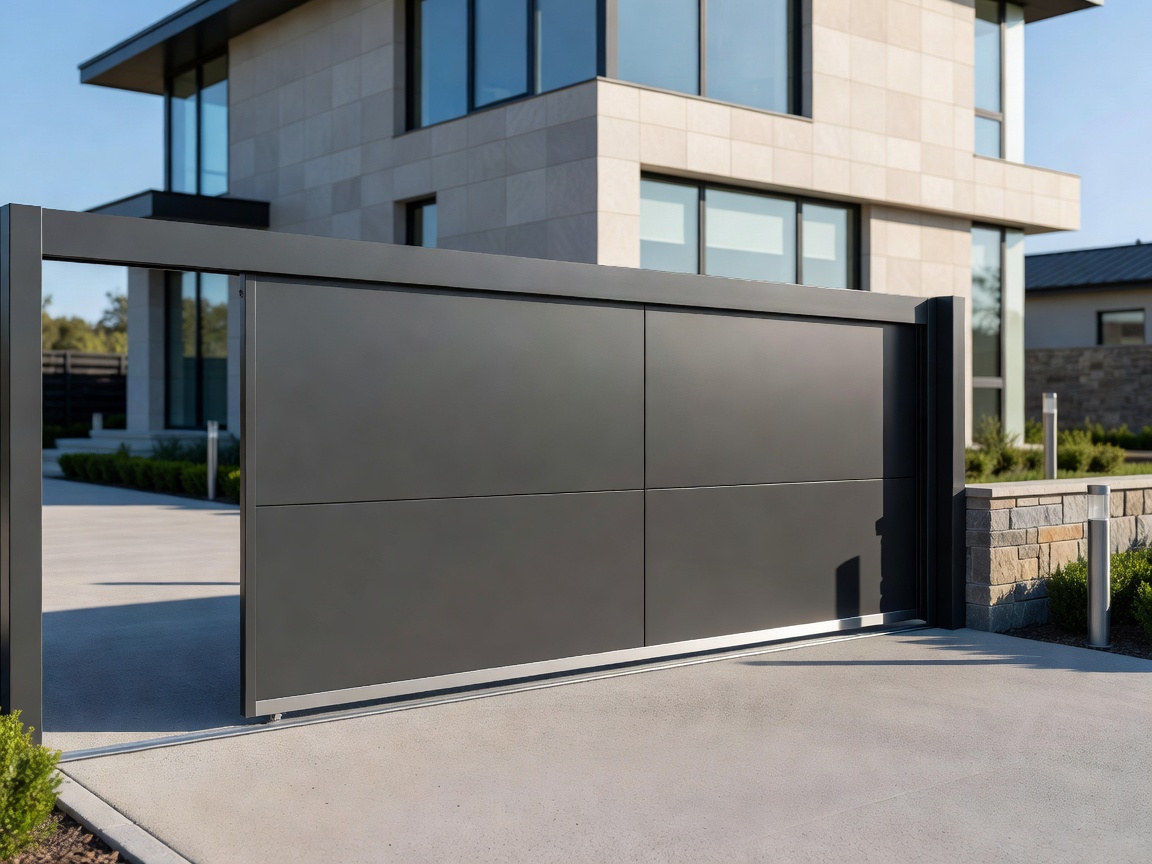
Track-Based vs. Cantilever Systems
We engineer sliding gates in two structural formats to suit ground terrain, soil stability, and boundary runoff availability.
Track-Based Systems
The gate rolls on steel v-groove wheels directly along an embedded ground track anchored to a continuous reinforced concrete foundation strip. Requires minimal side runoff (gate width + 0.5m) but benefits from occasional track clearing.
Cantilever Systems
The gate is suspended entirely above the driveway surface with no ground track across the driveway opening. An extended counterbalance tail rolls through enclosed ground-mounted carriage bearings, unaffected by snow, gravel, or ice.
Telescopic Configurations
For entrances with restricted lateral fence line space, multi-leaf telescopic sliding mechanisms stack leaves during opening, reducing required side runoff length by up to 50%.
Space Requirements & Driveway Considerations
Lateral Runoff Clearance
Track gates require clear fence line space equal to the driveway opening plus 500mm. Cantilever gates require the opening width plus approximately 30% to 35% extra space for the counterbalance tail.
Material Specifications
Fabricated in structural zinc-primed steel for broad spans, lightweight extruded architectural aluminium for corrosion resistance, or framed composite slats for warmth and privacy.
Ground & Gradient Factors
Ground must accommodate frost-line concrete anchors for cantilever blocks or laser-leveled bedding for ground tracks with integral water run-off drainage channels.
Manual vs. Automated Operation
Manual sliding gates glide effortlessly via low-friction spherical roller bearings with physical slam stops and hook locks. Automated setups integrate oil-bath rack-and-pinion motors with soft deceleration, obstacle detection, and manual release keys for power cuts.
- — Heavy-duty 24V or 230V commercial rack drives
- — Battery backup modules for uninterrupted operation
- — Optical safety edges on leading and trailing frame ends
Installation Process & Maintenance
From foundation trench excavation to tooth-rack alignment and electronic safety beam calibration, our six-stage process ensures zero vibration. Regular maintenance involves annual track cleaning and roller carriage lubrication.
- — Laser-verified guide tower vertical plumb
- — Encapsulated stainless steel roller carriages
- — Weather-sealed motor housing with magnetic limit switches
Sliding Gate FAQs
Is a cantilever sliding gate better than a tracked sliding gate?
Cantilever gates are superior for properties with gravel drives, heavy autumn leaf drop, or freezing winter snow because the gate floats 80–100mm above the surface without contacting the ground. However, tracked gates are ideal when lateral runoff along the fence is restricted.
How much space is needed beside the driveway for a sliding gate?
For a 4-metre tracked driveway opening, you need approximately 4.5 metres of straight, unobstructed fence line. For a 4-metre cantilever gate, you need approximately 5.4 to 5.6 metres to accommodate the counterbalance tail.
Can sliding gates be opened manually during a power failure?
Yes. Every automated sliding motor includes a keyed manual release clutch that disengages the internal gearbox, allowing the leaf to be pushed open and closed freely by hand.